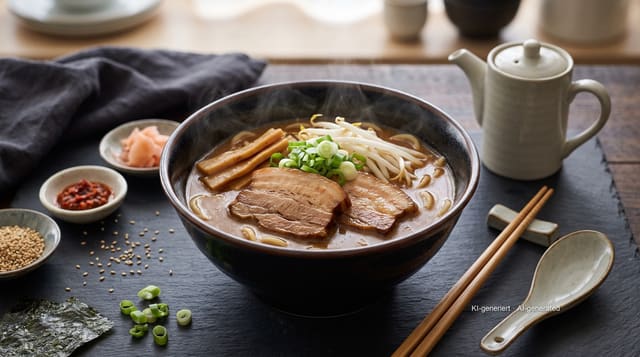
Aomori-style Miso Curry Milk Ramen
A Japanese classic from Tohoku: in the city of Aomori, at the very north of the main island of Honshu, this bowl has been a favourite with schoolchildren since the 1970s — thick, wavy noodles in a savoury, gently creamy broth that smells of miso and mild curry. Unlike Muroran-style Curry-Ramen, the broth here stays thin: miso, curry powder and milk meet in one bowl, a knob of butter or margarine melts on top, and bean sprouts and wakame add bite. A splash of sake gives the broth depth and contains alcohol, which cooks off during cooking.
45
minutes
4
servings
18
Ingredients

Instructions
Soak the wakame in a bowl of plenty of cold water. Meanwhile, peel and finely chop the garlic, peel and finely grate the ginger and cut the onion into fine strips. The wakame is ready when it is soft and bright green — it swells to several times its size.
Drain the wakame, squeeze it lightly with your hands and tear large pieces into bite-sized ones. Heat the sesame oil in a large pan over a medium heat and sweat the garlic, ginger and onion in it, stirring, until the onion is translucent and smells sweet; nothing should brown, otherwise the broth tastes bitter.
Dust over the curry powder and toast it briefly, stirring constantly, until it is strongly fragrant — in the hot fat the spices develop their full aroma, but they must not burn. Pour in the sake, which will hiss loudly, and let it bubble, stirring, until the pungent smell of alcohol has gone.
Pour in the tori chintan, loosen the browned bits from the bottom of the pan with the wooden spoon and bring everything to the boil once. Put a second large pan of plenty of unsalted water on to boil for the noodles.
Stir the white and dark miso pastes in a bowl with a ladleful of hot broth until smooth and no lumps are visible — this way the miso is distributed evenly instead of sitting in lumps in the pan. Turn the heat down to the lowest setting and stir in the dissolved miso, milk, soy sauce and sugar. From now on, only let the broth get hot until it steams, without boiling, otherwise the milk curdles and the delicate miso aroma evaporates.
Put the chashu slices into the hot broth for 30 seconds until the fat shimmers translucently, and lift them out again. Add the bean sprouts to the broth and leave them to steep over the lowest heat — by the time the noodles are ready, the sprouts are hot and still crunchy. Slice the spring onions into fine rings.
Fill four large bowls with hot water, leave them for a moment and pour the water away — in a warmed bowl the broth stays hot to the last spoonful. The bowls need no tare or oil here, because miso, curry and soy sauce are already in the broth.
Loosen the noodles with chopsticks in the rapidly boiling water and cook them: fresh thick noodles for about 3 minutes, dried ones according to the packet, until cooked but still al dente. Shake them vigorously in the sieve until hardly any water drips from them, because a lot of cooking water clings in the waves and would dilute the broth.
Divide the hot broth among the four bowls with a ladle, leaving the bean sprouts in the pan for now.
Add the noodles, lift them once with chopsticks and lay them back down loosely so that the broth gets caught in the waves and nothing sticks together.
Use a slotted spoon to pile the bean sprouts in a small mound in the middle of each bowl, and put 2 slices of chashu and a little heap of wakame next to them. Top each bowl with 10 g butter or margarine, sprinkle with the spring onions and serve the ramen immediately.
Edited by Peter Hölzer, head chef and master butcher
Similar recipes

Culinse · 45 min
Sendai-Miso-Ramen — Ramen with Red Sendai Miso

Culinse · 50 min
Tonjiru — Miso Soup with Pork and Root Vegetables
Culinse · 45 min
Niigata Noko-Miso-Ramen — Miso Ramen with Dilution Broth

Culinse · 55 min
Sapporo-style Miso-Ramen

Culinse · 45 min
Yonezawa-Ramen with Chicken and Anchovy Broth

Culinse · 60 min
Imoni — Yamagata-style Taro Stew with Beef

Culinse · 85 min
Kiritanpo-Nabe — Akita-style Rice Stick Hotpot with Chicken

Culinse · 60 min