ChineseDongbeiBasic recipeVegetarianVegan
Dongbei-Style Suan CaiLactic-Fermented Chinese Cabbage
A Chinese basic recipe from Dongbei: Suan Cai, literally ‘sour vegetable’, is the winter store of the north-east, for which whole halves of Chinese cabbage are wilted, scalded briefly, layered densely in a large pot and fermented lactically for three to four weeks in a light salt brine. Unlike sauerkraut made from finely shredded white cabbage, the halves stay whole, taste milder and fresher sour, and the leaf ribs become pale, almost translucent and crunchy. Finely cut, the sour cabbage goes into Dongbei-Style Suan Cai Jiaozi — with sour cabbage and pork, into Suan Cai Bai Rou Guo — sauerkraut hot pot with pork belly and in many families also into Zhurou Dun Fentiao — pork braised with glass noodles.
55
minutes
1
servings
4
Ingredients

Instructions
Take the wilted and damaged outer leaves off the Chinese cabbage, rinse the heads briefly, drain well and halve them lengthways, so that each half holds together at the stalk. Leave the halves, cut side up, to wilt in an airy, cool place for one to two days, until the leaves are soft and pliable and no longer break.
Bring the water for the brine to a rolling boil in a pot and leave it to cool completely, covered. Rinse a fermenting crock of about 6 litres or a large jar with very hot water and leave it to dry upside down on a clean cloth; the vessel and utensils must be clean and free of grease, and no metal may later lie directly on the cabbage.
Bring the water for scalding to a rolling boil in a large pot. Hold each cabbage half by the stalk with barbecue tongs, dip it completely for about 20 seconds until the leaves are a little darker and the ribs supple, lift it out and leave it, cut side down, on a rack to drain and cool.
Weigh the cooled cabbage and weigh the salt exactly: 2 per cent of the weight of the cabbage for sprinkling in (so for 2.4 kg of cabbage 48 g) and 20 g per litre for the brine. This even amount of salt lets the lactic acid bacteria work and slows unwanted germs; iodine and anti-caking agent interfere.
Layer the cabbage halves densely in the vessel, laying them alternately with the stalk to the left and right, sprinkle each layer with some of the weighed salt and press down firmly. Dissolve the remaining 40 g salt in the cooled water and pour it over until the cabbage is covered by a good 3 cm; leave 2 to 3 cm of space at the top.
Keep the cabbage under the brine with fermenting weights of stone or glass, or a clean plate with a glass filled with water standing on it, because anything that sticks out can spoil. With a fermenting crock, fill the channel with water; close a jar only loosely and stand it on a plate, because brine can overflow.
Leave the cabbage to ferment for three to four weeks at 15 to 20 °C in a dark place. In the first week check briefly every day that everything lies under the brine and open a jar briefly so that gas escapes; soon bubbles rise, the brine becomes cloudy and smells sour.
Eat it only after three weeks at the earliest, when the leaf ribs are pale and translucent and the cabbage tastes sour right to the middle, because in the first two weeks of fermentation a lot of nitrite forms, which is broken down again afterwards. Then transfer the halves with brine into smaller, clean jars, cover with brine and put them in the refrigerator.
Always take it out with clean, grease-free utensils and press the rest back under the brine; before cooking, rinse the leaves briefly, squeeze them out firmly and cut them finely. A flat white film on the surface is kahm yeast, harmless, and is skimmed off; if there is furry or coloured mould, throw everything away.
Edited by Peter Hölzer, head chef and master butcher
Similar recipes

Culinse · 100 min
Dongbei-Style Suan Cai Jiaozi — with Sour Cabbage and Pork
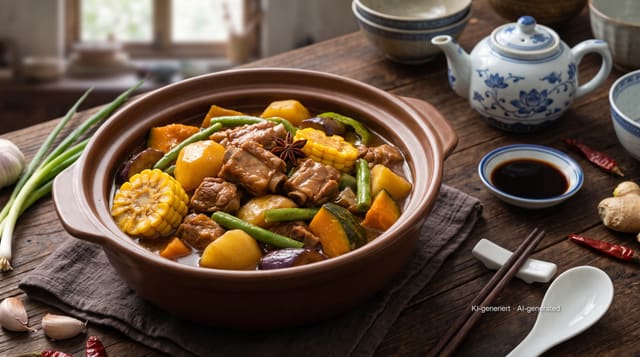
Culinse · 110 min
Dongbei Luandun — Braised Pot of Pork, Potatoes, Beans and Sweetcorn
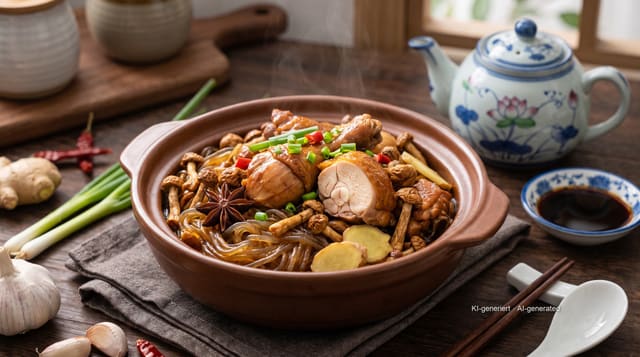
Culinse · 90 min
Xiaoji Dun Mogu — Chicken with Mushrooms and Glass Noodles, Dongbei Style

Culinse · 45 min
Di San Xian — Aubergine, Potato and Pepper Dongbei Style

Culinse · 110 min
Suan Cai Bai Rou Guo — Sauerkraut Hot Pot with Pork Belly
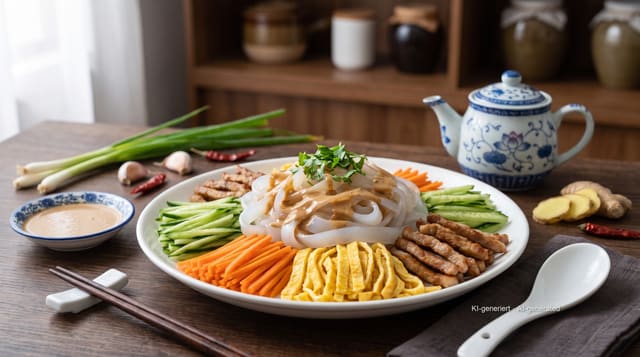
Culinse · 40 min
Da Lapi — Glass Noodle Sheets with Cucumber and Sesame Sauce

Culinse · 100 min
Tieguo Dun Yu — Iron Pot Fish with Cornbread Cakes

Culinse · 55 min