FrenchParis and Île-de-FranceBreakfastVegetarian
CroissantsFlaky Crescent Rolls
A French classic from Paris and the Île-de-France: croissants belong to the French breakfast, golden brown, flaky and crisp on the outside, soft inside with many fine, airy layers. The dough of flour, milk, yeast, sugar and salt rests overnight, the next day cold butter or margarine is worked in with three simple turns, and there are chilling pauses between all the steps, so that the baking is spread over two days, although the actual working time is only a little over an hour. Makes about 18 pieces.
107
minutes
18
servings
7
Ingredients

Instructions
The day before, mix the flour, sugar and salt in a bowl. Dissolve the yeast in the cold milk, pour it in and knead everything for 4 to 5 minutes into a smooth, rather firm dough, no longer, otherwise it contracts when you roll it out.
Press the dough into a flat rectangle about 2 cm thick, wrap it in cling film and leave to rest in the refrigerator overnight, for at least 8 and at most 16 hours.
On baking day, beat and roll the cold butter or margarine between two sheets of baking paper with the rolling pin into an even slab of 18 × 18 cm and chill. Dough and fat should be equally firm when laminating, cool and pliable but not hard.
Roll the dough out on the lightly floured work surface into a rectangle of about 20 × 38 cm. Lay the slab of fat on one half, fold the other half of the dough over it and press the edges firmly together so that the fat is completely enclosed.
For the first simple turn, roll the package out with even pressure into a rectangle of about 20 × 60 cm, brush off excess flour and fold the dough in three like a letter. Leave to rest in the refrigerator wrapped in cling film.
For the second turn, rotate the dough by 90 degrees so that the open edges lie at the top and bottom, roll it out again to 20 × 60 cm, fold in three and chill.
Do the third turn in the same way and then chill the dough for longer, so that it relaxes and does not contract when cut.
Halve the dough and roll each half out into a strip of about 25 × 55 cm and 4 mm thick. With a sharp knife cut triangles pointing alternately up and down with a base 10 cm wide, about 9 from each strip.
Stretch each triangle slightly lengthways, cut 1 cm into the middle of the base and roll the triangle up loosely from the base to the tip. Put them on two trays lined with baking paper, tip down and with the ends slightly curved, with space between them.
Beat the egg and brush the croissants thinly with it, without sticking the cut edges together. Leave to rise, loosely covered, at 24 to 26 °C until almost twice the size and wobbling when the tray is shaken; it must not be warmer, otherwise the fat melts out of the layers.
Preheat the oven to 200 °C conventional (top and bottom heat) and brush the croissants thinly with egg a second time.
Bake the trays one after the other on the middle shelf until the croissants are deep golden brown and clearly flaky.
Leave the croissants to cool on a wire rack so that the layers set.
Edited by Peter Hölzer, head chef and master butcher
Similar recipes

Culinse · 40 min
Croissants aux amandes — Almond Croissants with Almond Cream

Culinse · 60 min
Potage Parmentier — Potato and Leek Soup

Culinse · 40 min
Sauce béarnaise — Whisked Egg Yolk and Butter or Margarine Sauce with Tarragon

Culinse · 57 min
Baguette — French Stick Bread

Culinse · 17 min
Chocolat chaud à l'ancienne — Thick Hot Chocolate

Culinse · 105 min
Flan pâtissier — Custard Tart
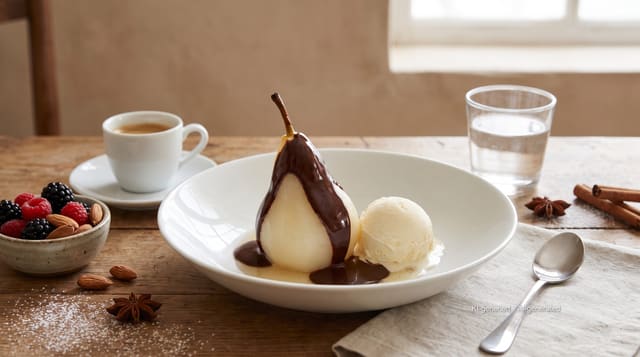
Culinse · 55 min
Poires Belle-Hélène — Pears with Chocolate Sauce

Culinse · 105 min