SpanishGaliciaCakeBaked goodsVegetarianVegan
Pan gallegoGalician Country Bread with Pre-Ferment and Thick Crust
A Spanish classic from Galicia: the large round country loaf with the little knob of dough on top, the moño, is the everyday bread all over the north-west and belongs on the table with octopus, stew and empanada. A pre-ferment that matures overnight and a soft dough with plenty of water and a long rise give it a thick, crisp, flour-dusted crust and a moist, open crumb with a mild, slightly sour aroma. Makes one loaf of about 800 g, enough for 12 portions.
80
minutes
12
servings
7
Ingredients

Instructions
The evening before, for the pre-ferment, stir the flour, room-temperature water and yeast in a bowl to a soft, sticky batter until no dry flour can be seen. Leave it, covered, at room temperature for 12 to 16 hours overnight, until it is full of bubbles, has domed and smells pleasantly sour.
The next day, dissolve the yeast for the main dough in the lukewarm water, add the pre-ferment and mix roughly with the flour for the main dough. Leave to swell, covered, so that the flour absorbs the water.
Scatter the salt over and knead the dough in the bowl or with the stand mixer until it is smooth, elastic and still clearly soft and sticky. Do not work in any extra flour, but work with wet hands and a dough scraper; the high proportion of water makes the open crumb.
Put the dough into a lightly oiled bowl and leave it to rest, covered.
Stretch and fold the dough: with wet hands, pull one side up and lay it over the middle, turn the bowl a quarter turn and repeat this four times all round. Leave to rest again, covered, and then stretch and fold a second time.
Stretch and fold a third time and then leave the dough, covered, to rise until it has almost doubled in size and shows bubbles on the surface.
Turn the dough out onto the well-floured work surface and take off a walnut-sized piece of about 60 g. Fold the rest of the dough from the outside in and shape it with tension into a round ball, and set it seam side down on a piece of baking paper. Roll the small piece into a ball, set it on top and press it firmly with a floured finger almost to the middle of the loaf, so that the moño holds during baking.
Dust the loaf generously with flour and leave it to rise, covered with a cloth, until it has visibly risen and a finger dent springs back only slowly.
In the meantime, at least 45 minutes before baking, preheat the oven to 250 °C conventional (top and bottom heat), heating a baking tray or a baking stone on the second shelf from the bottom as well, and put an ovenproof dish on the oven floor.
Slide the loaf with the baking paper onto the hot tray, pour 100 ml of hot water into the dish on the oven floor and close the door immediately; keep your face away from the rising steam. Start baking the bread in the steam.
Open the oven door briefly to let the steam escape, take out the dish with oven gloves and lower the temperature to 220 °C conventional (top and bottom heat). Keep baking until the crust is deep golden brown and thick and the loaf sounds hollow when you tap the underside.
Leave the bread to cool completely on a cooling rack before cutting it, because the crumb carries on cooking as it cools.
Edited by Peter Hölzer, head chef and master butcher
Similar recipes

Culinse · 215 min
Cocido gallego — Stew with Cabbage, Chickpeas, Lacón and Chorizo

Culinse · 160 min
Caldo gallego — Broth with Turnip Tops, Potatoes, White Beans and Lacón

Culinse · 60 min
Torta de almendras — Moist Flourless Almond Cake Galician Style
Culinse · 155 min
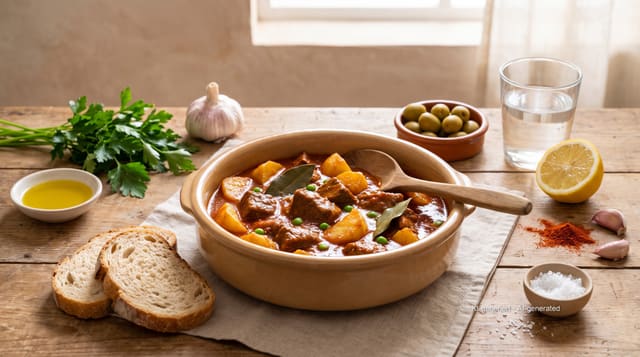
Carne richada — Galician Beef and Potato Casserole

Culinse · 60 min
Caldeirada de pescado — Galician Fish Stew with Potatoes and Paprika Oil

Culinse · 25 min
Masa de empanada gallega — Yeast Dough for the Galician Empanada

Culinse · 180 min
Lacón con grelos — Cured Pork Shoulder with Turnip Tops and Chorizo

Culinse · 50 min