ChineseGuangdongCakeBaked goodsVegetarianLactose-free
Cantonese Tang Nian GaoSweet Sticky Rice Cake for New Year
A Chinese New Year classic from Guangdong: Tang Nian Gao is a chewy, caramel-brown cake of sticky rice flour and brown sugar, which is steamed in Canton for the Spring Festival. Its name Nian Gao sounds in Chinese like ‘higher year by year’ and is therefore seen as a good wish for the new year. After an hour in the steam the cake cools through overnight in the refrigerator and is then fried golden yellow in slices with egg, finely crisp outside and soft, sweet and elastic inside.
100
minutes
12
servings
8
Ingredients

Instructions
Bring the sugar and water to the boil in a pot and stir until it has dissolved completely; roughly break up slab sugar first with a heavy knife. Take the syrup off the heat and leave it to cool until it is only lukewarm.
Mix the sticky rice flour and rice flour in a bowl, whisk in the lukewarm syrup little by little and add the oil. Stir until a smooth, thick batter with no lumps forms, and press it through a fine sieve into a second bowl.
Brush a round, solid, heatproof tin of 18 cm, made of metal or ceramic with no removable rim, thinly with oil, line the base with baking paper and pour in the batter. Cover the tin tightly with foil, so that no condensation drips from the lid onto the batter.
Bring about 5 cm of water to a rolling boil in a wok or wide pot and set on top a bamboo steamer or steamer insert into which the tin fits and whose base does not touch the water. Put the tin in, put the lid on and steam the cake over rapidly boiling water; check the water level every 20 minutes and top up with boiling water from the kettle.
Tilt the lid away from you and lift it off, as hot steam escapes, carefully take off the foil and push a wooden skewer into the middle: the cake may stick to it, but no liquid batter should be left on it; otherwise steam for another 10 minutes. Press the date into the middle of the hot, sticky surface or sprinkle the sesame seeds on.
Lift out the tin with oven gloves and leave the cake to cool completely in it. Then put it in the refrigerator, covered, overnight, because only when cold does it become firm enough to be cut.
Loosen the cold cake from the edge with an oiled knife, lift it out of the tin, peel off the baking paper and divide the cake into 12 pieces. For frying, cut as many pieces as you need into slices 1 cm thick with the oiled knife; for 4 people about 4 pieces are enough, and the rest stays covered in the refrigerator.
Beat the egg in a deep plate. Heat the oil in a non-stick frying pan over a medium heat, draw the slices through the egg, drain briefly and lay them side by side in the pan with a little space between them.
Fry the slices for 2 to 3 minutes on each side, turning once in between, until the egg is golden yellow and set on both sides; the egg cooks all the way through as it does, and the cake becomes soft inside.
Lay the slices briefly on kitchen paper and leave them to cool a little, because the melted sugar inside is very hot, then serve warm. The cake is soft, chewy and sticky: chew it well, and give it to small children and older people only in small pieces, because the chewy dough can get stuck in the throat.
Edited by Peter Hölzer, head chef and master butcher
Similar recipes

Culinse · 55 min
Cantonese-Style Plum Sauce

Culinse · 10 min
Cantonese Sweet and Sour Sauce — with Tomato and Rice Vinegar
Culinse · 80 min
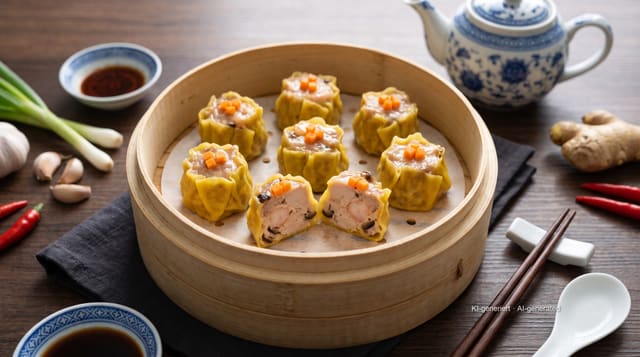
Cantonese Siu Mai — Open Dumplings with Pork and Prawns

Culinse · 30 min
Suan Tian Cai — Cantonese-Style Sweet and Sour Pickled Vegetables

Culinse · 60 min
Zha Yuntun — Deep-Fried Wontons with Sweet and Sour Sauce

Culinse · 18 min
Jin Yin Suan — Golden and White Garlic for Steaming
Culinse · 30 min
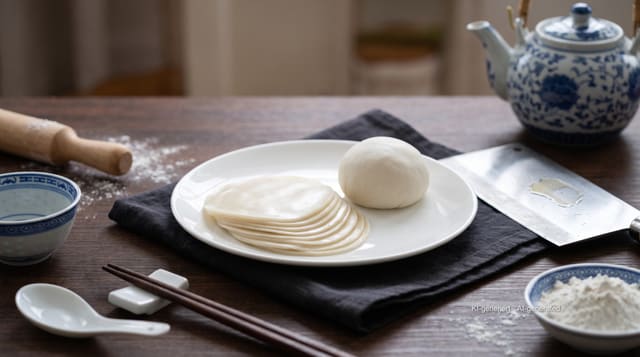
Dim Sum Dough from Wheat Starch — Translucent Wrapper for Har Gow

Culinse · 30 min