ChineseGuangdongBasic recipeVegetarianVegan
Dim Sum Dough from Wheat StarchTranslucent Wrapper for Har Gow
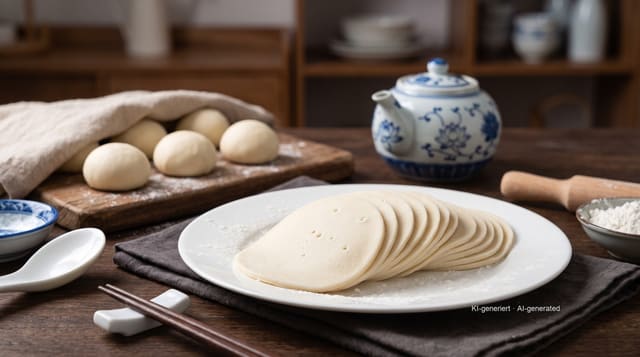
A basic Chinese recipe from Guangdong: the dim sum dough of wheat starch and a little tapioca starch is scalded with rapidly boiling water and gives a smooth, snow-white wrapper that turns glassy and almost transparent as it steams. It encloses Har Gow — crystal dumplings with prawns, through which the pink filling shimmers, and is just as suitable for vegetarian crystal dumplings. It is not rolled out: each piece of dough is pressed into a thin circle with the flat, oiled blade of a broad knife.
30
minutes
24
servings
5
Ingredients

Instructions
Mix the wheat starch, tapioca starch and salt thoroughly in a heatproof bowl. Bring the water to a rolling boil in a small pan; it must really be boiling as you pour it in, because only then does the starch bind and the dough becomes smooth instead of crumbly.
Pour the rapidly boiling water into the bowl all at once and stir vigorously at once with chopsticks until no dry starch can be seen. Hold the bowl firm with a cloth as you do and keep your face and hands out of the steam, because boiling water and the hot mixture scald easily. Cover the bowl at once and leave to stand, so that the starch swells further in its own heat.
Add the oil and, as soon as the dough can be handled, knead it on the work surface with the heel of the hand for 2 to 3 minutes, until smooth, white and supple. If it is crumbly, work in a teaspoon of hot water; if it sticks, a pinch of wheat starch. Wrap the dough in cling film at once, because it dries out in the air in a few minutes and is best shaped warm.
Take off a third of the dough, leaving the rest wrapped, and shape it into a roll about 2 cm thick. Cut the roll into 8 equal pieces of about 11 g each, roll each into a ball and put them under film.
Oil the flat blade of a broad knife or cleaver and a piece of the work surface thinly with kitchen paper. Flatten a ball, lay the blade flat on it, put the other palm on the blade and press down firmly, pushing the blade over the dough with a small twist, until an evenly thin circle of 7 to 8 cm results.
Loosen the circle from the work surface with the blade and put it under film; if it has turned out too thick or not round, roll it into a ball again and press anew. Treat the remaining balls, and then the other two thirds, in the same way, oiling the blade and work surface again as needed.
Fill and fold the wrappers straight away, for Har Gow as described there, and keep the finished dumplings under a damp cloth until steaming. If a wrapper tears as it is folded, the dough was too cold or too dry: knead the rest of the dough again with a teaspoon of hot water.
Edited by Peter Hölzer, head chef and master butcher
Similar recipes
Culinse · 40 min
Shengjian Dough — Half-Proved Dough for Pan-Fried Yeast Buns

Culinse · 45 min
Chaozhou-Style Gongfu Cha — Oolong in Small Infusions

Culinse · 70 min
Shaguo Doufu — Clay Pot Tofu with Chinese Cabbage and Pork

Culinse · 100 min
Cantonese Tang Nian Gao — Sweet Sticky Rice Cake for New Year

Culinse · 200 min
Luobo Niunan — Beef Brisket with Radish, Cantonese Style

Culinse · 30 min
Suan Tian Cai — Cantonese-Style Sweet and Sour Pickled Vegetables

Culinse · 18 min
Haoyou Jielan — Gai Lan with Oyster Sauce

Culinse · 30 min